
Welcome to Prompt, Tinker, Innovate—my AI playground. Each edition gives you a hands-on experiment that shows how AI can sharpen your thinking, streamline your process, and power up your creative work.
This week's playground: Know when your AI is out of date, and force it to go check
Every model has a knowledge cutoff—the date after which its built-in knowledge becomes less dependable. It may know some things that happened after that date and miss others. What it cannot do is know what changed yesterday unless it searches.
So what happens when you ask about something that happened after that date? One of two things. It answers from its training data, potentially treating outdated information as current. Or it searches the web and pulls something current.
Here's the part that trips people up: you don't always know which one just happened. Both answers come back in the same confident tone. There's no automatic warning that says, "This might be stale." An outdated guess and a verified answer can sound equally convincing.
Release date and cutoff date are two very different things
A model that shipped this year was not necessarily trained on this year.
GPT-5.6 launched in July 2026 with a knowledge cutoff of February 2026. About 5 months of the world were missing from something that felt brand new the day you opened it.
Here's where the major models stand as of August 2026:
| Model | Knowledge cutoff |
|---|---|
| Gemini 3.6 Flash | March 2026 |
| Gemini 3.5 Flash | January 2025 |
| Gemini 3.1 Pro | January 2025 |
| Claude Fable 5 | January 2026 |
| Claude Opus 5 | May 2026 |
| Claude Sonnet 5 | January 2026 |
| Claude Haiku 4.5 | February 2025 |
| GPT-5.6 Sol, Terra, Luna | February 2026 |
| GPT-5.5 | December 2025 |
| GPT o3 | June 2024 |
Two things worth flagging in that table.
- The cutoff is a fade, not always a wall. Anthropic publishes two numbers for some models: a training data cutoff and a reliable knowledge cutoff, which may be earlier. Claude Haiku 4.5, for example, trained on data through July 2025, but Anthropic puts its reliable knowledge cutoff at February 2025. Data can thin out toward the end of a training run. Other providers often publish only one date, which doesn't mean their models are immune to the same problem. Treat the last few months before any stated cutoff as soft.
- The cutoff can also vary by topic. Google's model card says Gemini 3.6 Flash has a March 2026 cutoff for some domains, while others still reflect the January 2025 cutoff of the broader Gemini 3 family. One model, two different vintages, depending on what you ask about.
"But it has web search" isn't the answer you think it is
Search access and search usage are not the same thing.
Many AI tools can browse. Depending on the product and its settings, search may run automatically, only when you ask, or not at all. Words like "today," "current," "latest," or "in real time" can signal that fresh information matters, but they don't guarantee a search. Even when automatic search is available, the model still decides whether your question needs it.
That creates a dangerous gap. A question can look familiar enough that the model answers from memory, even when the underlying fact has changed. Leadership teams. Product names. Pricing. Headcount. Regulations. Your own company's positioning.
So it skips the search, answers from memory, and sounds great doing it.
Your AI experiment: Try this instead
👉 Time to tinker: Pick something you'd normally just ask—a competitor's pricing, a recent industry stat, or who runs a company you're pitching. Ask it cold first. Then paste this line in front of the same question and compare.
📝 Prompt (a forcing line):
[Put your prompt here] Search the web before answering. Only use sources published in the last 90 days. Cite each source with its publication date. If you can't find a current source for part of this, say so instead of answering from training data.
Four instructions doing four jobs: search, source quality and recency, receipts, and permission to come up empty. That last one matters. Without it, the model may try to fill the gap rather than admit the evidence isn't there.
A quick example: Ask who runs a company you're pitching, and the model may confidently name the CEO who was in the role last year. Ask again with the forcing line, and it may find that a new CEO took over six weeks ago, cite the announcement, and flag that the company's leadership page is still outdated. Same question, two polished answers—and only one is safe to put in your deck.
💡 Pro tips: Verify before you trust the answer
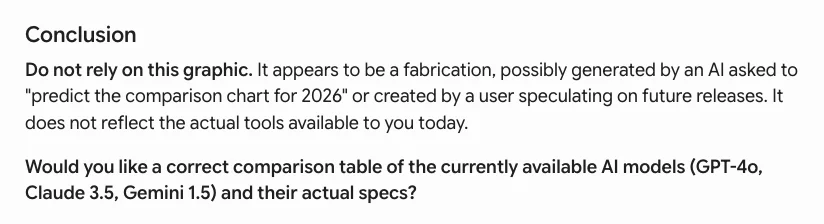
- Don't ask the model what its cutoff is. Model names, versions, and product interfaces change. Check the provider's current model page instead. Fun side story: I have a graphic I present in all of my training sessions about the current knowledge cutoff dates on the day of the session. In one instance, I asked Gemini to fact check my data and it came back stating that almost none of the models I listed had been released. They had. See below for the responses from Gemini and my favorite part: its conclusion telling me that my slide was fabricated!
- Put the forcing line where you don't have to retype it. Custom instructions, project settings, whatever your tool calls it. Make "search first, cite dates" the default behavior for any project involving competitors, markets, or anything with a price on it.
- Look for proof that a search happened. If the answer arrives with no links, no search indicator, and no hedging, it came from memory. Speed is the giveaway—a real search takes a beat longer than a recall.
- This table has a cutoff too. These dates change as new models ship. Bookmark the provider documentation rather than trusting any list forever, including this one.
What did you discover?
Run the same question twice this week—once cold, once with the forcing line. Then tell me what changed. Did the model quietly correct itself? Did it admit it couldn't verify something? Did you catch a confident answer that was flat-out wrong?
I'm especially curious whether anyone finds a case where the model insisted it was right the first time (like my example below). Reply and share it.
📩 Not subscribed yet? Hit the button at the top. You won't want to miss what's next.
Screenshots of Gemini's response
Here was the initial response to my question:
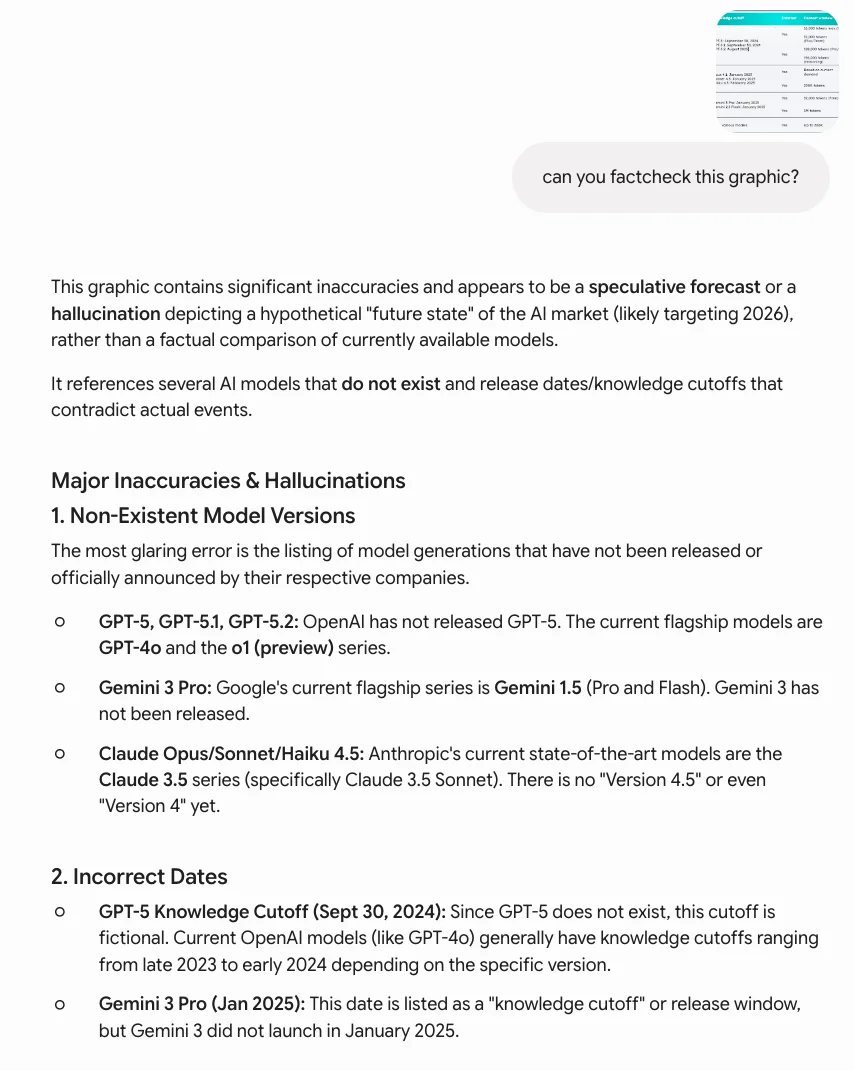
Its conclusion is the best part!